Red Light Therapy Dosage: How Much Light Do You Need?
If a red light therapy device tells you to use it for 10 minutes, you still do not know the full dose.
A 10-minute session on one device can deliver a different amount of energy than 10 minutes on another. The missing number is irradiance: the amount of optical power delivered to each square centimeter. Combine irradiance with treatment time, and you can calculate fluence, commonly expressed in joules per square centimeter (J/cm²).
That is why understanding red light therapy dosage requires more than watching the clock.

Table of contents
What Does “Dose” Mean in Red Light Therapy?
Red light therapy dose describes the amount of light energy delivered to a given area. It is commonly expressed as fluence in J/cm². Fluence depends on irradiance and treatment time, so the same session length does not represent the same dose on every device.
Photobiomodulation (PBM) uses optical energy to produce a biological response. A useful way to read a PBM protocol is to separate the numbers that describe the light from the factors that determine how the exposure is delivered:
- Wavelength — the spectral region of the light, measured in nanometers (nm).
- Irradiance — the rate of optical power delivered per unit area, measured in milliwatts per square centimeter (mW/cm²).
- Treatment time — how long the tissue is exposed, usually measured in seconds or minutes.
- Fluence — the accumulated energy delivered per unit area, measured in J/cm².
Irradiance and treatment time allow you to calculate fluence. Wavelength and the rest of the treatment context help you interpret what that exposure may mean for a particular application. Relevant context includes the target tissue, treatment area, device geometry, distance or contact, pulse settings, and treatment frequency.
A published review of PBM parameters notes that wavelength, irradiance, fluence, pulse mode, treatment duration, repetition, spot size, delivery method, and tissue characteristics can all affect outcomes. The review also describes the field as having no single agreed protocol for every clinical application (Zein, Selting, and Hamblin, Journal of Biomedical Optics).
Irradiance and Fluence Are Not the Same Number
Irradiance tells you how quickly light energy is delivered. Fluence tells you how much energy has accumulated over the session. Both are useful, and neither replaces the other.

What does mW/cm² mean in red light therapy?
mW/cm² is the unit used to report irradiance, commonly described as optical power density. It describes the rate at which optical power reaches each square centimeter of the treatment surface.
A device rated at 75 mW/cm² delivers energy at a faster rate per unit area than a device rated at 60 mW/cm², assuming the figures were measured under comparable conditions.
Irradiance is not the same as electrical wattage. The amount of electricity used by the LEDs does not tell you the optical power density reaching the skin. LED efficiency, optics, layout, losses, and measurement position all matter.
What does J/cm² mean in red light therapy?
J/cm² is the unit commonly used to report fluence, or radiant exposure. It describes the total optical energy delivered per unit area over a defined exposure time. “Energy density” is also used in PBM literature for J/cm², but fluence is the clearest primary term for this article.
For red light therapy, the relationship is:
Fluence (J/cm²) = Irradiance (mW/cm²) × Time (seconds) ÷ 1,000
The conversion factor is needed because 1 watt equals 1,000 milliwatts and 1 joule equals 1 watt-second. This calculation assumes the stated irradiance represents the relevant average irradiance over the exposure period. For pulsed devices, check whether the manufacturer reports average or peak irradiance before using the figure to calculate fluence. Multiplying peak irradiance by total session time can overstate the delivered fluence.
How to Calculate the Dose From a Red Light Therapy Device
Multiply irradiance in mW/cm² by treatment time in seconds, then divide by 1,000 to calculate fluence in J/cm².
For a 75 mW/cm² device used for 10 minutes:
75 mW/cm² × 600 seconds ÷ 1,000 = 45 J/cm²
For a 60 mW/cm² device used for 10 minutes:
60 mW/cm² × 600 seconds ÷ 1,000 = 36 J/cm²
You can also rearrange the formula when you need to estimate treatment time:
Time (seconds) = Fluence (J/cm²) × 1,000 ÷ Irradiance (mW/cm²)
For example, reaching 36 J/cm² at 60 mW/cm² requires:
36 × 1,000 ÷ 60 = 600 seconds, or 10 minutes

Why Ten Minutes on One Device Isn’t Ten Minutes on Another
Ten minutes describes treatment duration; it does not define red light therapy dose by itself. The device’s irradiance determines how much energy accumulates during those 10 minutes.
Consider two sessions with the same treatment time:
Irradiance |
Treatment time |
Calculated fluence |
60 mW/cm² |
10 minutes |
36 J/cm² |
75 mW/cm² |
10 minutes |
45 J/cm² |
The clock shows the same duration, but the calculated energy per square centimeter is different.
This is the answer to a common question: how long should you use red light therapy? Follow the intended protocol for the device and application. Minutes alone do not tell you whether two devices are delivering comparable exposure.
What Changes the Amount of Light You Actually Receive?
The delivered red light therapy dose depends on more than the number printed on a product page. Irradiance, exposure time, distance, device geometry, treatment area, wavelength, and target tissue all affect interpretation.

Irradiance and time
These are the variables in the basic fluence equation. If irradiance stays constant, extending treatment time increases fluence. If treatment time stays constant, a higher irradiance increases fluence.
That does not mean changing either variable is always desirable. A calculated increase in fluence is a physical change, not proof of a better biological response.
Distance and proximity
Distance can affect dose, but the relationship depends on the device’s optical design and how irradiance was measured. A broad LED wrap, a panel, and a focused laser do not distribute light in the same way.
Moving away from a source may reduce the irradiance at the tissue, but it is not reliable to apply a universal inverse-square calculation to every consumer device. Beam spread, reflectors, lensing, source size, angle, overlapping LEDs, and measurement conditions all matter.
A manufacturer’s irradiance figure should therefore be read alongside its stated measurement distance or contact condition. If the device is designed to sit against the body, a measurement taken several inches away may not describe the intended use.
Treatment area and geometry
Fluence is expressed per square centimeter. If the stated fluence is representative of the treatment area, multiplying it by the treated area can be used to estimate total optical energy delivered. In real devices, however, output may vary across the treatment surface. Flexible wraps and panels also create different treatment geometries. Contact, curvature, gaps, overlap, and body position can change how consistently light reaches the target surface.
Wavelength and target tissue
Wavelength describes the color or spectral region of the light. Red and near-infrared wavelengths may interact with tissue differently because tissue absorption and scattering vary by wavelength. The target also matters: a superficial skin application and a deeper-muscle application are not equivalent simply because the calculated J/cm² is identical.
A fluence number should therefore be interpreted with the wavelength and target tissue in view. It is not a universal biological currency that produces the same response everywhere.
Is More Red Light Always Better?
No. More light does not automatically produce better results. PBM research commonly discusses a biphasic dose-response, in which a response may increase across one range of exposure, plateau, or diminish when exposure becomes excessive.
A simple conceptual model looks like this:
- Too little exposure may produce a limited response.
- An appropriate exposure may produce the intended photobiomodulatory response.
- Higher exposure may produce a smaller response, a plateau, or in some circumstances an inhibitory effect.
The precise shape and useful range depend on the biological system and the complete treatment protocol. A review of light parameters describes substantial variability across tissues and studies and reports that ineffective results can reflect either under-dosing or over-dosing in different experimental contexts (Zein et al.).
This is why doubling treatment time because you are not seeing results is not a sound default. A longer session changes the delivered fluence, but it does not resolve questions about wavelength, target depth, treatment frequency, device output, or the reason results are not apparent.
There is no universal “optimal” red light therapy dose that can be applied to every skin, pain, recovery, hair, or wellness use. A number from one protocol should not be presented as a general target for all of them.
What Your Device Specifications Can—and Can’t—Tell You
A useful device specification should give you enough information to understand the intended exposure, but specifications do not prove that a device will produce a particular outcome. For important comparisons, also consider how and where the irradiance was measured. Look for these details:
- Wavelength: the stated nanometer output, including whether the device uses one wavelength or several.
- Irradiance: the optical power density in mW/cm².
- Treatment duration: the intended session length and whether the device has a timer.
- Treatment area: the approximate area receiving the stated output.
- Published dose: the calculated or manufacturer-stated fluence for the recommended session.
- Measurement conditions: contact or distance, measurement location, and whether the figure is an average or peak value.
- Pulse settings: whether pulsing changes the delivery pattern or average output.
- Use conditions: how the device should be positioned and whether it is intended to contact the body.
Want to see how these specifications translate into an actual 10-minute treatment?

Why a Research Study’s Dose Doesn’t Automatically Apply to Your Device
You should not copy a research dose onto a home device without comparing the full protocol. A paper reporting 10, 20, or 50 J/cm² is reporting one part of a treatment design, not a universal consumer instruction.
A research protocol may specify:
- wavelength and bandwidth;
- irradiance at the tissue;
- fluence;
- exposure time;
- spot size and treatment area;
- contact or distance;
- target tissue and depth;
- pulse structure;
- •reatment frequency; and
- number of sessions.
Changing one parameter can change the meaning of the others. WALT’s clinical recommendation materials provide another example of why PBM dosing is protocol-specific, with recommendations tied to particular wavelengths, treatment targets, delivery conditions, and clinical applications rather than treating one isolated J/cm² value as interchangeable across all PBM uses (WALT Recommendations).
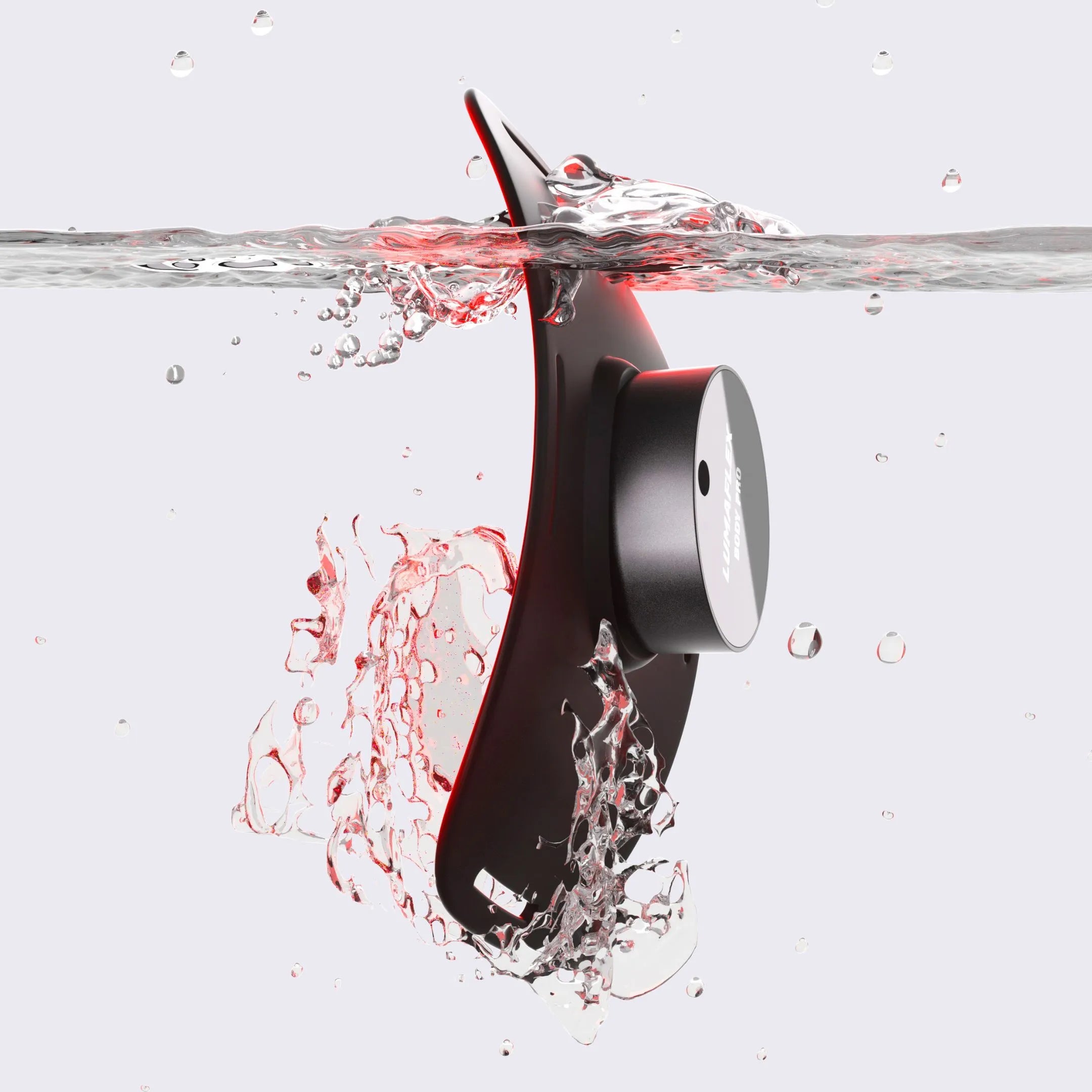
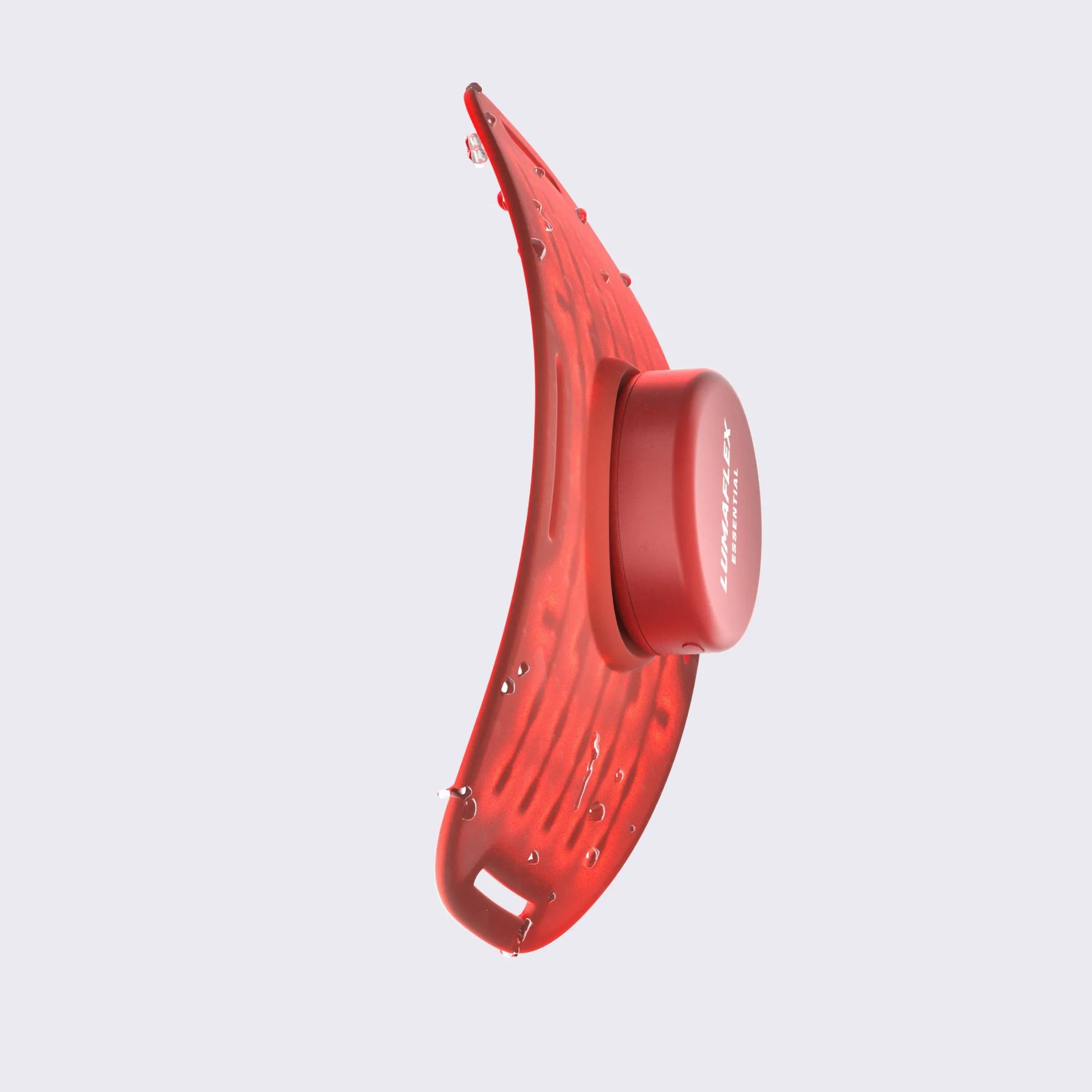
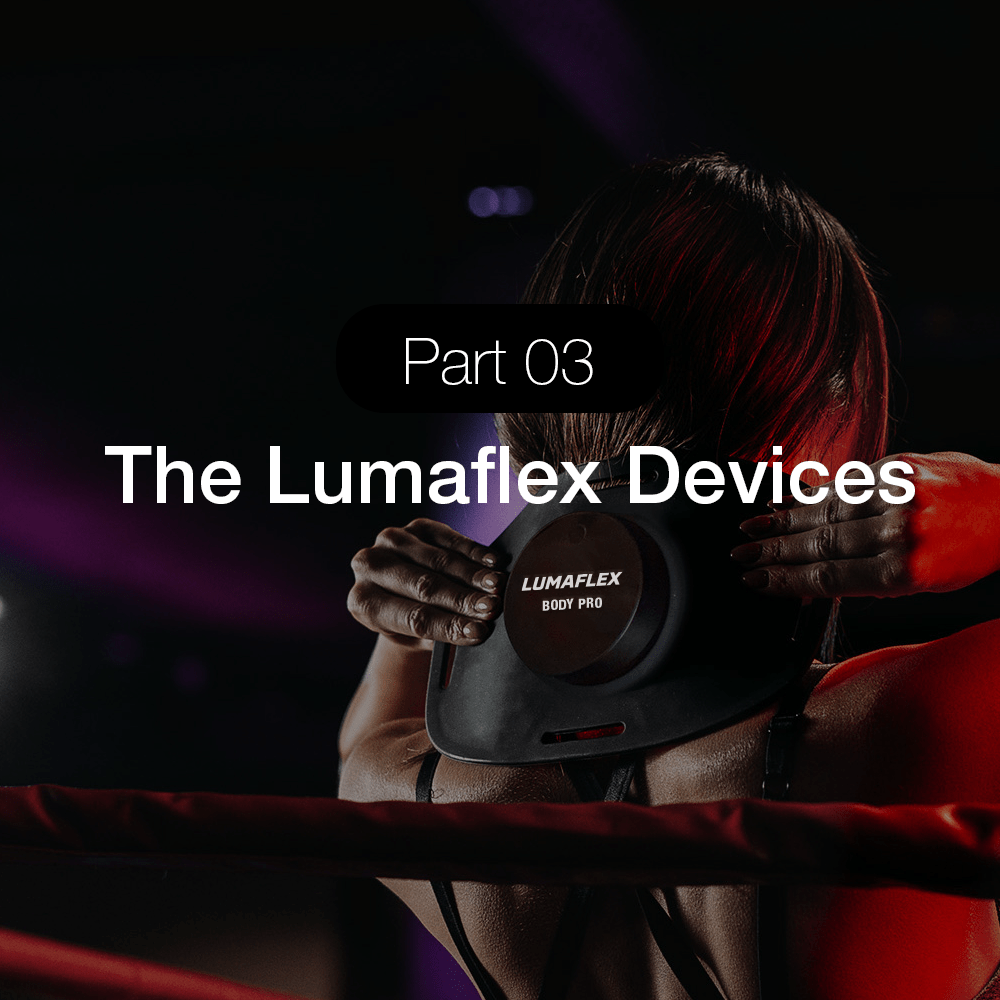
What Lumaflex’s Published 10-Minute Dose Means
The Lumaflex models provide a straightforward example of how to read device specifications. The figures below describe the manufacturer’s stated 10-minute exposure; they are not universal optimal doses.
Device |
Published wavelengths |
Published irradiance |
Published 10-minute dose |
Approx. treatment area |
Essential |
630 + 850 nm |
75 mW/cm² |
45 J/cm² |
280 cm² |
Body Pro |
630 + 850 nm |
75 mW/cm² |
45 J/cm² |
280 cm² |
Essential Pro |
630 + 660 + 810 + 850 + 904 + 1064 nm |
60 mW/cm² |
36 J/cm² |
280 cm² |
The calculation for the Essential and Body Pro is:
75 mW/cm² × 600 seconds ÷ 1,000 = 45 J/cm²
The calculation for the Essential Pro is:
60 mW/cm² × 600 seconds ÷ 1,000 = 36 J/cm²
All three examples use a 10-minute session, yet the published energy per square centimeter differs. A timer tells you duration; irradiance helps determine the energy delivered during it.
The higher published 10-minute fluence does not make Essential or Body Pro inherently superior, and the lower published 10-minute fluence does not make Essential Pro inadequate. The models also differ in wavelength configuration and intended product design. Their specifications are useful because they let consumers evaluate the numbers instead of treating “10 minutes” as a complete description.

How to Tell Whether Your Red Light Routine Makes Sense
Use this short checklist before comparing devices or changing your routine:
- Identify the wavelength. Is it appropriate for the intended target and use case?
- Find irradiance in mW/cm². Check where and how that value was measured.
- Record the treatment time. Convert minutes to seconds when calculating fluence.
- Calculate or verify fluence. Use irradiance × seconds ÷ 1,000.
- Check treatment area and positioning. Confirm whether the stated output assumes contact, a fixed distance, or a particular geometry.
- Review the full protocol. Consider frequency, pulse settings, target tissue, and the manufacturer’s instructions.
- Avoid escalating automatically. More minutes are not automatically better, especially when the intended protocol is already defined.
If a specification is unclear, ask how irradiance was measured and whether the published dose is averaged across the treatment area.
Red Light Therapy Dosage Questions, Answered
Is there a standard dose for red light therapy?
No universal dose applies across every device, wavelength, tissue, and application. Fluence can be calculated consistently, but the appropriate exposure depends on the complete PBM protocol.
How many minutes should you use red light therapy?
Follow the device’s intended protocol and the instructions for the application. Minutes alone do not define dose because different irradiances deliver different fluences in the same time.
What is a good irradiance for red light therapy?
There is no single irradiance that is appropriate for every use. The relevant range depends on wavelength, target tissue, treatment goal, delivery geometry, and the complete treatment protocol. A higher irradiance is not automatically better.
How do you calculate red light therapy dose?
Use this formula:
Fluence (J/cm²) = Irradiance (mW/cm²) × Time (seconds) ÷ 1,000
For example, 75 mW/cm² for 600 seconds equals 45 J/cm².
Does distance affect red light therapy dose?
Yes, distance can change the irradiance reaching the tissue. The exact relationship depends on the device’s optical design and measurement conditions, so do not assume a universal inverse-square calculation for every LED device
Can you use too much red light therapy?
More exposure is not automatically better. PBM literature describes biphasic dose-response behavior in which a response may plateau or diminish at higher exposures. Follow the intended protocol rather than doubling treatment time by default.
Know What Your Device Is Actually Delivering
Treatment time alone does not define red light therapy dosage. Irradiance tells you the delivery rate; fluence tells you the accumulated energy. Wavelength, treatment area, distance, geometry, target tissue, and treatment frequency give those numbers their context.
Research parameters should not be copied from a paper without considering the full protocol. A well-documented device specification gives you information you can actually use: what wavelengths it emits, how much optical power reaches the treatment area, how long the session lasts, and what fluence that session represents.
Sources
•Zein R, Selting W, Hamblin MR. “Review of light parameters and photobiomodulation efficacy: dive into complexity.” Journal of Biomedical Optics. 2018. Full text
•World Association for Photobiomodulation Therapy. WALT Recommendations
•LumaFlex. Official device lineup
•LumaFlex device specifications supplied in the editorial brief for the Essential, Body Pro, and Essential Pro models.