What Happens When One PBM Device Enters Family Life?

A real family experience shows how PBM can move from personal recovery to shared household use and why the same protocol should not be copied.
Photobiomodulation, or PBM, is increasingly discussed beyond professional rehabilitation and research settings. Portable devices allow people to explore red and near-infrared light as part of routines built around exercise, physical exertion, localized discomfort, and everyday recovery. This article follows one family’s experience as a device moved from one person’s recovery routine into a shared household environment.
But when a device moves from one person’s routine into a household, an important distinction becomes necessary: a shared device does not create a shared medical protocol. Family members may use the same technology, but their ages, physical conditions, treatment areas, activity levels, and health needs can differ substantially.
This family’s experience makes that principle tangible. It can show how people incorporate a device into daily life and what they report noticing. It cannot, by itself, establish that PBM caused a particular medical improvement. The account discussed here is therefore a real-world experience, not a clinical trial, product efficacy study, or treatment recommendation.
Table of contents
What is photobiomodulation?
Photobiomodulation uses low-intensity visible red and/or near-infrared light. It is sometimes called low-level light therapy or red light therapy. PBM is not primarily intended to heat tissue; researchers study whether particular light exposures may influence biological processes at the cellular and tissue levels.
Proposed mechanisms include interactions with mitochondrial processes, cytochrome c oxidase, ATP-related activity, nitric-oxide signaling, reactive oxygen species, calcium signaling, transcription factors, and cellular adaptation. These mechanisms should be understood as proposed and context-dependent, rather than as one universally established chain of events.
The response to PBM depends on more than whether a device emits red light. Wavelength, irradiance, fluence or dose, pulse pattern, session duration, treatment timing, treatment area, distance from the tissue, tissue characteristics, and biological state may all influence how much light reaches a target and how tissue responds.
That is why broad statements such as “PBM boosts ATP” or “red light increases circulation” are too general without specifying the relevant protocol and outcome. A more accurate description is that PBM may influence mitochondrial, metabolic, vascular, inflammatory, or neurophysiological processes under particular conditions. The clinical meaning of those effects depends on the population, device, dose, and goal being studied.
630 nm red light and 850 nm near-infrared light

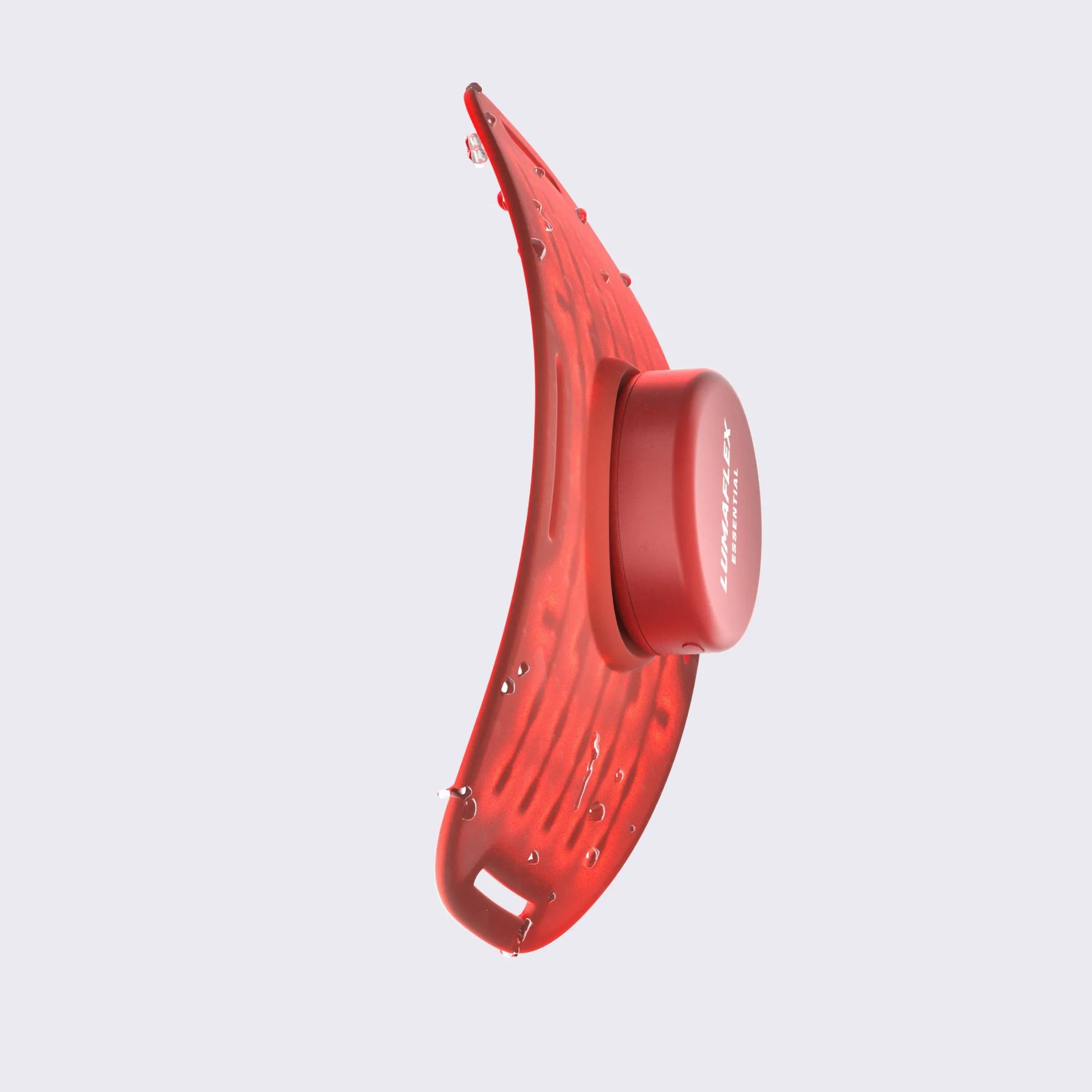
The Lumaflex Essential product page currently lists 630 nm red light and 850 nm near-infrared light, along with red irradiance of 45 mW/cm², near-infrared irradiance of 30 mW/cm², and a 10-minute treatment session.[3] Users should follow the current product labeling and user manual.
At a high level, 630 nm red light is often discussed in relation to more superficial targets, while 850 nm near-infrared light may reach relatively deeper tissue. This is a general distinction, not a hard boundary. Actual penetration and energy distribution depend on tissue composition, skin characteristics, device geometry, contact or distance, irradiance, dose, and other treatment parameters.
The difference between wavelengths therefore does not mean that 630 nm “works on the skin” while 850 nm automatically “reaches deep tissue.” Nor does it mean that one wavelength is universally better. A device combining wavelengths may provide a broader range of possible applications, but the appropriate use still depends on the treatment goal and the instructions for the specific device.
What does the research show?
PBM is an active area of clinical research, but the evidence is not uniform across conditions, protocols, devices, wavelengths, doses, or outcomes. A 2025 umbrella review evaluated 15 meta-analyses covering 204 randomized clinical trials, more than 9,000 participants, 35 health endpoints, and 15 conditions.
The review reported statistically significant effects for some outcomes, while the certainty of evidence varied. Several findings had moderate certainty, whereas many others were supported by low or very low certainty because of factors such as heterogeneity, small studies, and possible publication bias.[4]
The appropriate principle is simple: match the claim to the study. If research examines a particular condition, population, wavelength, dose, device, and endpoint, the finding should remain within those boundaries. A positive result in one research context does not automatically become a general statement that PBM “improves recovery.” General PBM research also does not prove that a particular consumer device produces every outcome described by users.
This distinction is especially important when interpreting real-world family experiences. Controlled research can test whether an intervention produces a measurable effect under defined conditions. A household account answers different questions: Can people incorporate the device into daily life? Which body areas do they choose? Do they find the routine practical? What experiences and safety questions emerge outside a laboratory?
Both forms of information can be useful, but they should not be confused.

A family’s experience with PBM
The family described here began using PBM because of the mother’s recurring lower-back discomfort and the physical demands of caring for a young child. Her daily activities included carrying, bending, standing, pushing a stroller, walking for extended periods, and repeating these tasks over time. The discomfort did not arise from a clearly defined sports injury; it was associated with cumulative everyday strain as she described it.
During one outing, she pushed a stroller for four consecutive days and walked approximately 7,000 to 8,000 steps per day. After returning home, she used a red-light device on her legs and reported that the fatigue felt quickly relieved.
That account is a subjective user report, not a measured clinical outcome. There was no comparison condition, standardized fatigue scale, blinded assessment, or way to separate the effect of PBM from rest, sleep, reduced activity, expectation, or the natural change in fatigue over time. The most defensible interpretation is not that PBM rapidly relieved fatigue. Rather, the experience illustrates how an at-home device can become part of a recovery routine after repeated everyday physical activity.
On another occasion, the mother reportedly experienced recurring lower-back discomfort after repeatedly lifting her approximately 32-pound child. She described a sensation around the right thoracolumbar-to-lumbosacral region as “lightning-like.” She reported using the device on both sides of her lower back and later noticing that the sensation was less pronounced.
This episode should not be presented as evidence that PBM treated nerve pain, lumbar strain, sciatica, inflammation, or a back injury. The underlying cause was not established, and the reported use should not be turned into a reader instruction. In particular, a reported 20-minute session should not be treated as a general recommendation when the current product information lists a 10-minute automatic treatment session.[3]
When a device becomes a family technology
As the mother’s routine became familiar, the family also explored the device in connection with the child’s daily abdominal care. The parents described a history of infrequent bowel movements and reported that, after using PBM on the child’s abdomen for several consecutive nights, bowel movements appeared more regular.
This is an observational and exploratory account. It does not establish that PBM treated constipation, improved digestion, regulated bowel function, or provided a pediatric health benefit. Children’s use requires additional consideration of age, tissue characteristics, physiological development, physical condition, treatment area, device instructions, and professional guidance where appropriate. Children are not simply smaller adults, and an adult’s routine should not be copied automatically.
The value of this part of the experience is conceptual rather than therapeutic. It shows how a device may move from one person’s recovery routine into a family environment. It also demonstrates why the appropriate application cannot simply be transferred from one family member to another.
Shared technology, individualized application

A family PBM model is not “one device, one protocol, and everyone uses it the same way.” It is better represented as shared technology plus individualized application.
Family members may differ in age, physical condition, activity level, tissue characteristics, treatment area, recovery goal, tolerance, and medical circumstances. Even one person’s needs may change with exercise, work, childcare, prolonged standing, walking, travel, or repetitive physical activity.
For that reason, wavelength, dose, irradiance, duration, distance, pulse parameters, and treatment site should not be copied arbitrarily between users. Device flexibility does not mean that every setting is appropriate for every person. The current labeling and user manual should take priority over a family member’s personal routine or an anecdotal account found online.[3]
PBM’s potential breadth of application comes from its parameter-dependent nature, not from a claim that one wavelength or one device universally works for every need. Research into mitochondrial energy metabolism, redox balance, local blood flow, inflammatory signaling, and neurophysiological processes provides a basis for studying PBM across different contexts.[1] [2] But a common biological mechanism does not mean that one protocol is suitable for every person or condition.
What real-world experience can—and cannot—show

A real-world account may help illuminate how people incorporate PBM into daily life, which body areas they choose, whether they can maintain a routine, and how they describe comfort or recovery. It may also identify practical barriers and generate questions for formal research.
It cannot establish causation, clinical effectiveness for a diagnosis, comparative effectiveness, an appropriate dose for everyone, pediatric safety or efficacy, or that a symptom change resulted from PBM. It cannot show that one user’s protocol should be copied by another family member.
A more informative future record could document baseline symptoms, treatment area, device mode, session duration, treatment frequency, concurrent treatments, follow-up timing, functional changes, adverse events, and whether a clinician confirmed the underlying condition. Such documentation would still not become a randomized trial, but it would make the experience more transparent and useful for identifying research questions.
Responsible use and medical safety
PBM should be considered an adjunct to a broader health or recovery routine, not a replacement for medical care, diagnosis, exercise, sleep, nutrition, or stress management. Users should follow the current product labeling and user manual and should not assume that longer or more frequent sessions are better.
PBM should not be used to diagnose unexplained symptoms or to decide whether urgent medical evaluation is necessary. Severe, worsening, or unexplained symptoms require appropriate medical attention. Seek urgent care for warning signs such as severe or worsening abdominal pain, trouble breathing, facial or throat swelling, fainting, or other emergency symptoms. If a user experiences unexpected pain, excessive heat, a new skin reaction, or another unexpected effect, they should stop and follow the device instructions or seek professional advice.
People with relevant medical conditions, those taking photosensitizing medications, and anyone with concerns involving pregnancy or the treatment area should discuss use with a qualified healthcare professional. Pediatric use requires particular caution and should not be inferred from an adult protocol or from a single family experience
Frequently asked questions
What is photobiomodulation?
Photobiomodulation is the use of low-intensity visible red and/or near-infrared light to investigate or influence biological processes under specific exposure conditions. It is also commonly called low-level light therapy or red light therapy, although the biological response depends on more than the label used for the light.
What is the difference between 630 nm red light and 850 nm near-infrared light?
630 nm red light is often discussed in relation to more superficial targets, while 850 nm near-infrared light may reach relatively deeper tissue. Actual penetration depends on tissue and treatment parameters, so the distinction should not be treated as an absolute rule.
Can PBM replace medical care?
No. PBM should not delay diagnosis or treatment, especially when symptoms are acute, severe, worsening, or unexplained. Readers seeking a broader overview can consult a dedicated guide to at-home photobiomodulation, while this article focuses on family use and evidence interpretation.
Why do wavelength, irradiance, dose, and session length matter?
PBM is parameter-dependent. These factors influence how much light reaches tissue and how the body may respond. More exposure is not automatically better, and readers should follow the current instructions for their specific device.
Are user testimonials evidence that red light therapy works?
Testimonials are evidence of what a person reports experiencing. They are not controlled evidence of causation or proof that a device treats a specific condition. Research findings must be interpreted according to the population, protocol, device, and outcome studied.
Can different family members use the same PBM device?
A device may be shared, but application should be individualized according to age, physical condition, treatment area, device instructions, and appropriate professional guidance. Family members should not automatically copy one another’s protocols.
PBM Device: Family Life
Photobiomodulation in the home may become part of routines built around physical activity, childcare, work, travel, rest, and recovery. A family experience can make that possibility tangible: a pbm device family life first adopted for one person’s daily physical strain may eventually become part of a household’s broader health routine.
But the experience does not prove that PBM caused a particular symptom change, treated a diagnosis, or is appropriate for every family member. The responsible interpretation is narrower and more useful. Technology can be shared, but application needs to be individualized. Understanding that distinction allows readers to consider family use of PBM with curiosity while keeping evidence, product instructions, and medical safety in view.
Medical disclaimer: This article is for educational purposes only and is not medical advice. Photobiomodulation is not a substitute for diagnosis or treatment by a qualified healthcare professional. Individual responses vary. Follow the current device labeling and seek urgent care for emergency symptoms.
References
[1]: https://pubmed.ncbi.nlm.nih.gov/28189906/ Hamblin MR. “Mechanisms and applications of the anti-inflammatory effects of photobiomodulation.” AIMS Biophysics. 2017;4(3 ):337–361. DOI: 10.3934/biophy.2017.3.337.
[2]: https://doi.org/10.1109/JSTQE.2016.2561201 de Freitas LF, Hamblin MR. “Proposed mechanisms of photobiomodulation or low-level light therapy.” IEEE Journal of Selected Topics in Quantum Electronics. 2016;22(3 ):7000417. DOI: 10.1109/JSTQE.2016.2561201.
[3]: https://www.lumaflex.com/products/the-essential Lumaflex. “The Lumaflex Essential.” Official product page.
[4]: https://pubmed.ncbi.nlm.nih.gov/40770824/ Son Y, et al. “Effects of photobiomodulation on multiple health outcomes: an umbrella review of randomized clinical trials.” Systematic Reviews. 2025;14(1 ):160. DOI: 10.1186/s13643-025-02902-3.